Iran Escalation and African Fruit Exports: What Exporters and Insurers Must Watch Now
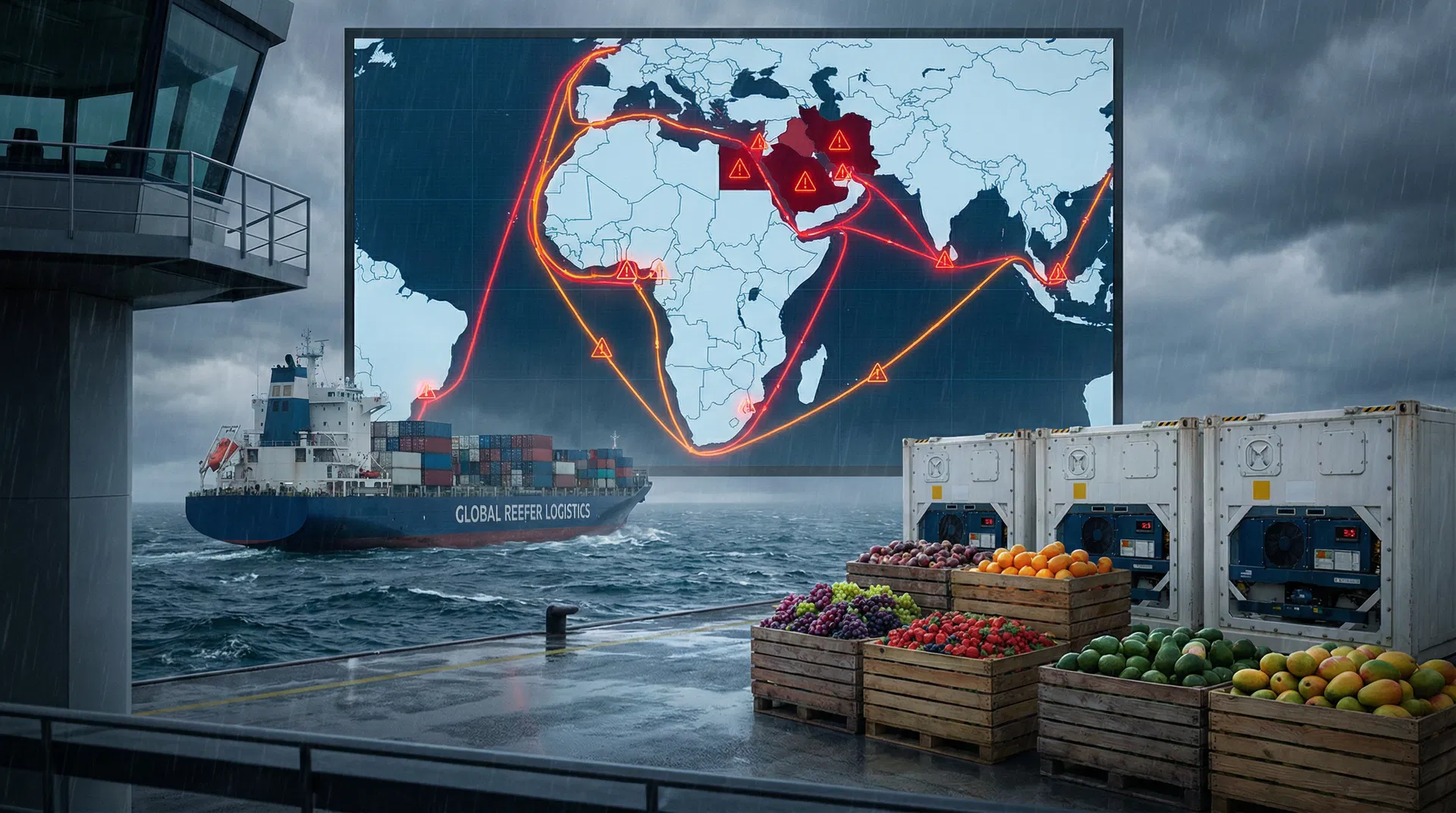
Geopolitical events rarely damage fruit directly. But they change the conditions under which fruit travels.
When regional conflict escalates in the Middle East, the consequences quickly spread across global logistics networks. Shipping routes shift. Transit times become unpredictable. Carrier decisions change. For exporters of perishable cargo, these disruptions can quietly erode shelf life, market value, and ultimately the viability of entire shipments.
Why This Conflict Matters for African Fruit Exports
Africa exports large volumes of fresh fruit to global markets during the early months of the year. These seasonal flows are highly concentrated in specific regions and move through international shipping corridors that are sensitive to geopolitical instability.
Key African Fruit Export Flows
These shipments move through international shipping corridors that are sensitive to geopolitical instability. When conflict disrupts maritime traffic, exporters face immediate operational consequences that place stress on the cold chain and threaten cargo viability.
Immediate Impact: The First 7–10 Days
The earliest effects of regional escalation are operational rather than biological. Shipping schedules begin to shift. Vessels may alter routes. Port congestion may increase. Transit windows may change. For perishable cargo, these disruptions place immediate stress on the cold chain.
Program Disruptions
Late fruit arrivals and lower market prices as shipments miss optimal market windows
Reefer Cold Chain Stress
Increased pressure on refrigeration systems during extended transit times and route changes
Reduced Shelf Life
Technical disputes over product condition as fruit ages during unpredictable transit
The Evidence Shield: Documentation Checklist
At this stage, the most important protection is documentation. Exporters should maintain a strong evidence shield, including:
These records become critical if cargo quality disputes arise later. They provide the factual foundation for defending claims.
Mid-Term Impact: Three to Four Weeks
After several weeks of disruption, a different type of risk begins to appear. Fruit physiology starts to change. Small shifts in temperature exposure and transit time can lead to maturity acceleration and reduced shelf life.
Fruit Physiology Changes
Unseen maturity shifts reduce shelf life, making fruit unmarketable even if physically undamaged.
Logistics Complexity
Greater reliance on forwarders and subcontractors reduces visibility over critical handling decisions.
Market Dynamics Shift
Delayed shipments may arrive into oversupplied markets, forcing renegotiations between exporters and buyers. This creates a secondary layer of commercial risk beyond the physical cargo condition. Buyers may reject fruit citing quality issues that are actually driven by market timing rather than genuine deterioration.
At this stage, the logistics chain becomes more complex. The diagram highlights two operational challenges: greater reliance on forwarders and subcontractors, and reduced visibility over who is responsible for critical handling decisions. This fragmentation increases the difficulty of determining liability if quality problems arise.
Longer-Term Impact: Four to Eight Weeks
By the time disruptions persist for several weeks, the industry begins to adapt. Export programs adjust harvest timing. Packing standards may tighten. Buffer periods may increase. These operational adjustments help absorb uncertainty in the logistics chain.
Program Resilience
- • Tightened maturity standards
- • Larger buffer periods
- • Earlier harvesting schedules
Claims & Analysis Activity
- • Technical investigations begin
- • Pre-cooling procedures scrutinized
- • Cold chain integrity analyzed
However, claims activity also begins to increase. Technical investigations may focus on pre-cooling procedures, packing standards, cold chain integrity, and the precise timing of temperature deviations. Proving the deterioration mechanism becomes central to recovery efforts. Companies that maintained strong documentation during the immediate and mid-term phases are far better positioned to defend their position.
How Exporters Should Respond to Carrier Reactions
One of the most common responses from carriers during geopolitical disruptions is the assertion that delays were caused by force majeure or operational necessity. Understanding this dynamic is critical for protecting recovery rights.
1. Preserve Operational Data
Maintain handover records, loading temperatures, and reefer monitoring logs. These documents prove the specific conditions under which cargo was transported.
2. Issue Timely Notice
Provide written notice of potential claims and involve surveyors early. This creates a formal record of your position and preserves your legal rights.
3. Separate Delay from Causation
Identify whether cargo deterioration resulted from logistics failures such as terminal handling errors or reefer malfunction, rather than from the delay itself.
These steps help protect recovery rights if disputes arise later. The key is demonstrating that while the conflict introduced uncertainty, the actual deterioration resulted from specific operational decisions or failures—not from the geopolitical situation itself.
The Critical Distinction Exporters Must Understand
The conflict itself does not damage fruit.
Operational decisions made during disruption do. The conflict introduces uncertainty. But deterioration results from how the cold chain is managed during that uncertainty.
This distinction is crucial for claims recovery. Exporters and insurers who maintain strong operational discipline remain far better positioned to defend claims. They can demonstrate that:
Why Evidence Discipline Matters More Than Ever
In volatile logistics environments, the difference between a rejected claim and a successful recovery often comes down to evidence. Companies that maintain strong documentation across the cold chain can reconstruct exactly what happened during transit. Those that cannot are left arguing from assumptions.
The Evidence Advantage
Can reconstruct exactly what happened, defend their position with facts, and recover losses from responsible parties.
Are left arguing from assumptions, cannot prove their case, and face rejected claims or reduced recoveries.
A Practical Guide for Exporters and Insurers
The Impact of Regional Escalation (Iran) on African Fruit Exports guide provides a visual breakdown of the immediate, mid-term, and longer-term consequences of regional instability on perishable cargo supply chains. It includes practical frameworks for navigating carrier responses and protecting recovery rights.
Download the Impact of Regional Escalation Guide
Get a comprehensive visual reference guide covering immediate, mid-term, and longer-term consequences of geopolitical disruption on African fruit exports, plus practical frameworks for protecting your position.
Download PDF GuideIn the Fruit Trade, Geopolitical Conflict Does Not Spoil Cargo
But the logistics consequences often do. Understanding how regional escalation affects perishable supply chains is essential for exporters, insurers, and logistics professionals. The key to protecting your position is maintaining disciplined evidence practices and understanding the distinction between geopolitical uncertainty and operational failure.
Companies that document their operations meticulously are far better positioned to recover losses when disruptions occur.
Need Help Managing Geopolitical Risks or Resolving Claims?
Our team specializes in perishable cargo disputes and geopolitical supply chain risks. Let us help you design better transport strategies, navigate carrier disputes, and recover losses from disrupted shipments.
Book a Free Strategy Call