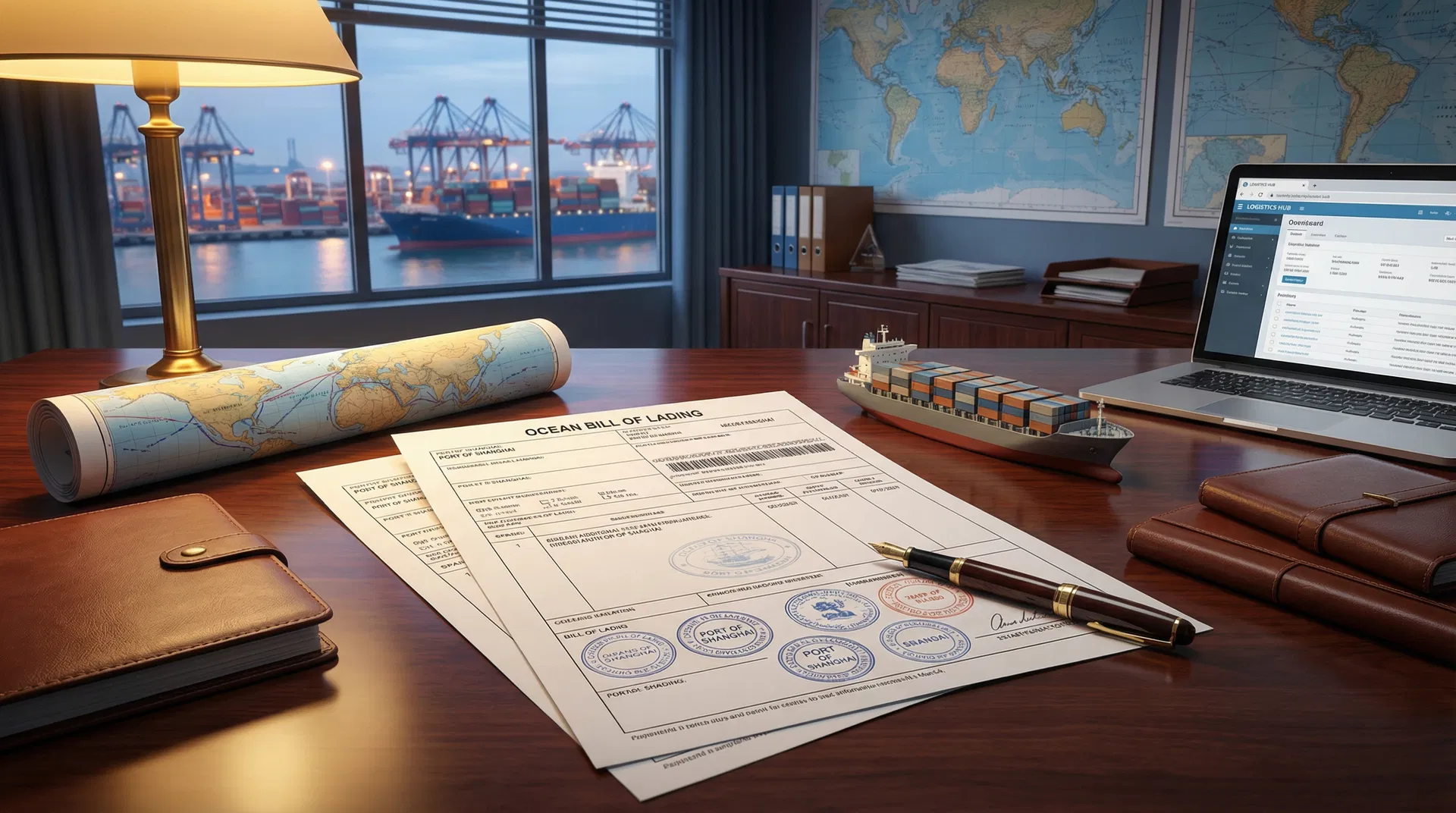
The Bill of Lading Explained: The Most Important Document in Global Shipping
Every international shipment revolves around one document. Not the invoice. Not the packing list. The Bill of Lading.
For exporters, freight forwarders, insurers, and cargo owners, the Bill of Lading is the document that determines who owns the cargo, who is responsible for it, and how claims will be handled if something goes wrong. Understanding this document is essential for anyone involved in global trade.
What a Bill of Lading Actually Is
A Bill of Lading (B/L) is far more than a shipping receipt. It performs three critical legal functions in international trade that make it one of the most powerful documents in global logistics.
Receipt for Cargo
Confirms that goods were loaded in good order and condition
Evidence of Contract of Carriage
Establishes the legal agreement between shipper and carrier
Document of Title
Allows the cargo to be transferred to another party, determining legal ownership
Because it functions as a document of title, possession of the original Bill of Lading can determine who is legally entitled to claim the cargo at destination. This is why it remains one of the most powerful documents in global logistics.
The Key Information Contained in a Bill of Lading
Although formats vary between shipping lines, most Bills of Lading include the same essential elements. Errors in any of these fields can later complicate claims, customs clearance, or cargo release.
Essential B/L Elements
These elements establish the contractual framework governing the shipment. Accurate completion and careful review before shipment is essential to avoid later complications.
The Three Core Functions of a Bill of Lading
The Bill of Lading plays several operational roles during the shipment lifecycle. Understanding each function is critical for cargo professionals.
Cargo Receipt
When a carrier issues the Bill of Lading, it confirms that the cargo has been received in the stated condition. If damage or discrepancies exist, the carrier may issue a claused Bill of Lading, noting visible defects. This distinction becomes critical in cargo claims, as a clean B/L indicates the cargo was received undamaged.
Contract of Carriage
The Bill of Lading defines the contractual obligations between shipper and carrier. These terms often include liability limitations, delivery conditions, claims deadlines, and applicable maritime law. Many Bills of Lading incorporate international conventions such as the Hague or Hague–Visby Rules, which regulate carrier liability and limit claims to specific amounts.
Document of Title
Perhaps the most powerful feature of the Bill of Lading is that it allows ownership of cargo to be transferred during transit. This enables sale of cargo while in transit, use of cargo as collateral in trade finance, and transfer of ownership through endorsement. This is why banks frequently require original Bills of Lading in letters of credit transactions.
Types of Bills of Lading
Different types of Bills of Lading exist depending on the transaction structure. Each type affects how cargo ownership and risk transfer operate during the shipment.
Straight Bill of Lading
Cargo is consigned directly to a named consignee and cannot be transferred to another party.
Order Bill of Lading
Transferable by endorsement, commonly used in trade finance and letters of credit transactions.
Bearer Bill of Lading
Ownership belongs to whoever physically holds the document, making it highly negotiable.
Multimodal Bill of Lading
Covers shipments involving multiple transport modes such as sea, rail, truck, and air.
Electronic Bill of Lading
Digital versions designed to improve efficiency, reduce paperwork, and enhance security.
House Bill of Lading
Issued by freight forwarders rather than the actual carrier, used in consolidation services.
The Clauses That Determine Liability
Bills of Lading contain several standard clauses that heavily influence cargo disputes and claims outcomes. Understanding these clauses is critical when evaluating potential cargo claims.
Paramount Clause
Defines which legal framework governs the contract of carriage (e.g., Hague-Visby Rules)
Jurisdiction Clause
Specifies the court or arbitration forum for disputes, affecting where claims must be filed
Force Majeure Clause
Defines situations where the carrier may be exempt from liability (war, strikes, natural disasters)
Demurrage and Detention Clauses
Outline costs associated with delays in cargo handling and return of equipment
Freight Prepaid Clause
Specifies whether freight is paid in advance or upon delivery, affecting consignee obligations
Liability Limitation Clause
Caps the carrier's financial liability per container or per kilogram of cargo
The Bill of Lading and Cargo Claims
Many cargo disputes ultimately revolve around the Bill of Lading. Because the B/L establishes the contract of carriage, it often becomes the central document in recovery actions.
Common Claim Issues Related to B/L
- •Cargo Damage During Transit: B/L condition notation determines liability
- •Short Delivery or Discrepancies: B/L quantity vs. actual delivery
- •Misdelivery of Cargo: B/L consignee vs. actual recipient
- •Delayed Shipments: B/L voyage dates vs. actual delivery
- •Liability Limitation Disputes: Clauses limiting carrier responsibility
For this reason, accurate completion and careful review of the Bill of Lading before shipment is essential. Any discrepancies should be addressed immediately with the carrier to ensure a clean B/L that protects your rights in case of future disputes.
The Rise of Electronic Bills of Lading
Traditionally, original paper Bills of Lading were required for cargo release. However, electronic Bills of Lading are increasingly being adopted across the shipping industry, offering significant advantages.
Faster Document Transfer
Eliminates delays associated with physical document delivery and courier services
Reduced Fraud Risk
Digital signatures and blockchain technology prevent document forgery and tampering
Lower Administrative Costs
Reduces printing, storage, and courier expenses associated with paper documents
Improved Supply Chain Efficiency
Enables real-time document transfer and faster cargo release at destination
Despite these advantages, legal and technological challenges still affect widespread adoption. Many countries have not yet established legal frameworks for electronic B/L recognition, and some carriers and banks remain hesitant to adopt the technology.
How to Avoid Common Bill of Lading Mistakes
Experienced cargo professionals typically follow several best practices to prevent B/L-related issues. Even small errors can later delay cargo delivery or complicate recovery claims.
Double-check cargo descriptions and quantities against commercial invoices and packing lists
Verify shipper and consignee information is accurate and matches the letter of credit
Confirm freight terms and Incoterms alignment with the sales contract
Address any discrepancies with the carrier before shipment to ensure a clean B/L
Keep secure records of original documents and maintain a copy for your files
Review all B/L clauses carefully, especially liability limitations and jurisdiction clauses
Ensure the B/L matches the booking confirmation and shipping instructions
Request a clean B/L (no 'claused' notations) unless damage is visible and documented
The Document That Controls the Shipment
In international trade, many documents support the transaction. But the Bill of Lading remains the one document that links the cargo, the carrier, the buyer, the seller, and the financing bank.
Understanding how it works is essential for anyone involved in global logistics. The Bill of Lading is not just a receipt—it is a legal instrument that determines ownership, establishes liability, and governs how disputes are resolved.
In shipping, cargo moves across oceans. But the Bill of Lading determines who controls it.
Download the Bill of Lading Masterclass
Get a comprehensive visual reference guide covering B/L structures, clauses, claims procedures, charter party relationships, and best practices for international shipping.
Download PDF MasterclassNeed Expert Guidance on B/L Disputes or Documentation?
Our team specializes in resolving cargo disputes related to Bill of Lading issues. Let us help you protect your rights and recover losses from shipping disputes.
Book a Free Strategy Call